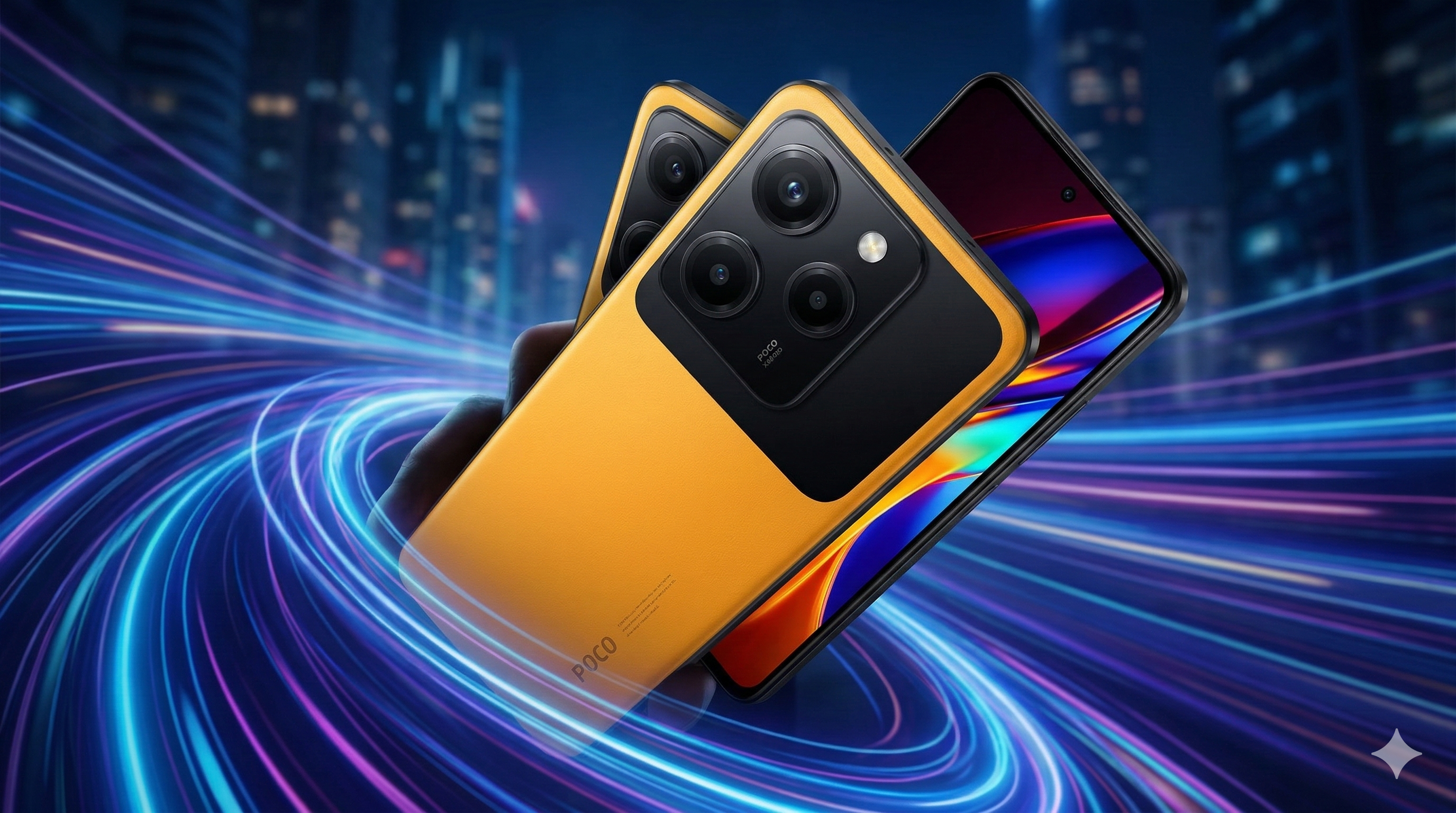
Editor's note: This article combines launch-period brand signals with retailer listings and ongoing leak reporting. Final India pricing, memory variants, and some hardware details had not been formally published by POCO at the time of writing, so unconfirmed information below is described as expected or reported.
POCO's next X-series phone is being widely tipped for a March 17, 2026 launch window in India, with early reports pointing to a 7,560mAh battery and 100W fast charging on the POCO X8 Pro. In a market where most phones in this segment still ship with 4,500mAh to 5,500mAh batteries, that would make the X8 Pro one of the more interesting endurance-focused launches if the reported specifications hold up.
Current reporting suggests the Poco X8 Pro may be related to the Redmi Turbo 5 platform, while several key details — including price positioning, battery size, and the possibility of a Pro Max model — continue to come from third-party reporting rather than a full official specification sheet. We've kept that distinction clear throughout this page so readers can judge the information appropriately.
What's Reported So Far
- Expected launch timing: March 17, 2026
- Reported Poco X8 Pro starting price: approximately Rs 43,000
- Reported Poco X8 Pro Max starting price: approximately Rs 57,000
- Expected processor lineup: MediaTek Dimensity 8500 Ultra / Dimensity 9500s
- Reported battery sizes: 7,560mAh (X8 Pro) / 9,000mAh (X8 Pro Max)
- Expected charging: 100W wired fast charging
- Reported camera: 50MP Sony IMX882 (OIS) main sensor
- Expected display: 1.5K OLED/AMOLED, 120Hz, up to 3,500 nits
- Reported durability: IP68 + IP69 dust and water resistance
- Expected software: HyperOS 3 based on Android 16
Poco X8 Pro Expected Price in India — All Variants
While POCO hasn't officially revealed the Indian pricing, multiple reliable leaks from European retailers and tipsters suggest the following price structure. Based on POCO's historical pricing strategy for the Indian market, these prices are expected to be slightly lower than the European counterparts when converted to INR.
The Poco X8 Pro is expected at approximately EUR 399 (roughly Rs 43,000) for the base 8GB RAM + 256GB storage variant. The higher 12GB RAM + 512GB storage model could cost around EUR 479 (approximately Rs 51,000). This places the Poco X8 Pro squarely in the mid-premium segment, competing against the likes of the Samsung Galaxy A56, OnePlus Nord 5, and iQOO Neo 10.
The premium Poco X8 Pro Max is tipped to start at EUR 529 (around Rs 57,000) for the 12GB + 256GB configuration, going up to EUR 579 (approximately Rs 62,000) for the maxed-out 12GB + 512GB variant. At this price, it will compete directly with the OnePlus 14R, Samsung Galaxy S25 FE, and the Realme GT 7 Pro.
POCO is also expected to offer launch-day discounts, bank offers, and exchange deals on Flipkart India, which could bring the effective price down by Rs 3,000 to Rs 5,000 during the initial sale period.
Poco X8 Pro vs Poco X8 Pro Max — Full Specifications Comparison
Here's a detailed side-by-side comparison of the Poco X8 Pro and Poco X8 Pro Max to help you decide which model offers the best value for your budget. Both smartphones share the same design language but differ significantly in processor, display size, battery capacity, and camera hardware.
| Specification | Poco X8 Pro | Poco X8 Pro Max |
|---|---|---|
| Display | 6.59-inch 1.5K OLED, 120Hz, 3,500 nits | 6.83-inch 1.5K AMOLED, 120Hz, 3,500 nits |
| Processor | MediaTek Dimensity 8500 Ultra (4nm) | MediaTek Dimensity 9500s (3nm) with Arm Mali-G925 |
| RAM | 8GB / 12GB LPDDR5x | 12GB / 16GB LPDDR5x |
| Storage | 256GB / 512GB UFS 4.1 | 256GB / 512GB UFS 4.1 |
| Rear Camera | 50MP Sony IMX882 (OIS) + 8MP ultra-wide | 50MP Light Fusion 600 (OIS) + 8MP ultra-wide |
| Front Camera | 20MP Samsung OV20B | 20MP Samsung OV20B |
| Battery | 7,560mAh | 9,000mAh |
| Charging | 100W wired fast charging | 100W wired fast charging |
| Software | HyperOS 3 based on Android 16 | HyperOS 3 based on Android 16 |
| Durability | IP68 & IP69 rating | IP68 & IP69 rating |
| Fingerprint | Ultrasonic in-display | Ultrasonic in-display |
| Connectivity | 5G, Wi-Fi 6E, Bluetooth 5.4, NFC, IR blaster | 5G, Wi-Fi 7, Bluetooth 5.4, NFC, IR blaster |
| Dimensions | 162.5 x 75.7 x 8.4 mm | 165.1 x 77.2 x 8.6 mm |
| Weight | 205g | 221g |
| Colors | Black, Blue, Silver | Black, Green, Silver |
Why the 7,560mAh Battery Changes Everything
The POCO X8 Pro's 7,560mAh battery is one of the largest ever fitted in a mainstream smartphone at this price point. To put this in perspective, the Samsung Galaxy S25 Ultra packs a 5,000mAh battery, the iPhone 16 Pro Max has a 4,685mAh battery, and even the OnePlus 14 Pro comes with 6,000mAh. The POCO X8 Pro blows them all away with a cell that is over 50% larger than most flagships.
In real-world usage, this massive battery translates to an estimated 2 full days of moderate use on a single charge. For heavy users — those who constantly stream video, play games, and use GPS navigation — the Poco X8 Pro should comfortably last a full day with battery to spare. The MediaTek Dimensity 8500 Ultra's 4nm manufacturing process further enhances battery efficiency compared to older 6nm or 7nm chipsets.
And when it does run low, the 100W wired fast charging means you can go from 0 to 100% in approximately 42 minutes. A quick 10-minute charge gives you enough juice for several hours. That combination effectively makes carrying a power bank unnecessary for the vast majority of users, which is exactly what POCO is marketing — a phone that outlasts your day, every day.
The Pro Max variant takes this even further with an absolutely massive 9,000mAh battery — the same 100W charging means full top-up in about 55 minutes, with the phone potentially lasting nearly 3 days for light users. For travelers and professionals who can't always access a charger, these numbers are game-changing.
MediaTek Dimensity 8500 Ultra Performance Breakdown
The MediaTek Dimensity 8500 Ultra powering the Poco X8 Pro is built on TSMC's 4nm process and features an octa-core CPU with one Arm Cortex-A725 prime core clocked at up to 3.36GHz, three Cortex-A725 performance cores at 3.0GHz, and four Cortex-A520 efficiency cores at 2.0GHz. The GPU is the Arm Mali-G720 MC6, which delivers console-quality gaming performance.
In terms of benchmark comparison, the Dimensity 8500 Ultra scores approximately 1,350,000 on AnTuTu v10, placing it between the Qualcomm Snapdragon 8 Gen 2 and Snapdragon 8 Gen 3 in raw performance. For gaming, it handles popular titles like BGMI, Genshin Impact, and Call of Duty Mobile at high settings with stable frame rates. The chip also supports advanced AI features including on-device generative AI, smart photo enhancement, and real-time language translation.
Paired with LPDDR5x RAM running at up to 8,533 Mbps and UFS 4.1 storage with sequential read speeds exceeding 4,200 MB/s, the Poco X8 Pro delivers flagship-grade multitasking and app loading speeds. Whether you're switching between 20 apps, editing 4K video, or running split-screen multitasking, the phone should handle everything without breaking a sweat.
Poco X8 Pro Camera Deep Dive — 50MP Sony IMX882 with OIS
Photography is another strong suit of the Poco X8 Pro. The main camera uses the 50MP Sony IMX882 sensor, which is a 1/1.56-inch sensor with Optical Image Stabilization (OIS). This sensor has been praised across multiple devices for its excellent color accuracy, dynamic range, and low-light performance. The f/1.59 aperture allows more light to hit the sensor, resulting in brighter and more detailed photos even in challenging lighting conditions.
The secondary camera is an 8MP ultra-wide lens with a 120-degree field of view — ideal for landscape photography, group shots, and architectural photography. On the front, a 20MP Samsung OV20B sensor handles selfies and video calls, supporting 1080p video recording at 60fps for smooth, high-quality video.
On the software side, the POCO X8 Pro benefits from HyperOS 3's AI-powered camera features, including AI Photo Enhancement (automatically adjusts exposure, contrast, and sharpness), AI Night Mode (multi-frame noise reduction for ultra-low-light shooting), AI Portrait Mode with background blur, and AI Object Eraser for removing unwanted objects from photos. Video capabilities include 4K recording at 30fps, 1080p at 60fps with EIS, and slow-motion up to 960fps at 720p.
The Poco X8 Pro Max upgrades to the 50MP Light Fusion 600 sensor, which features an even larger 1/1.3-inch sensor size, delivering superior low-light performance and finer detail capture. This is the same sensor class used in flagship-tier smartphones, making the Pro Max a compelling option for photography enthusiasts.
Display Quality — 1.5K OLED with 3,500 Nits Brightness
The Poco X8 Pro features a stunning 6.59-inch 1.5K OLED display with a resolution of 2712 x 1220 pixels, delivering sharp text and vibrant visuals. The display supports a 120Hz adaptive refresh rate that dynamically switches between 30Hz, 60Hz, 90Hz, and 120Hz depending on the content being displayed — saving battery when scrolling through static pages and ramping up for smooth gaming and video.
The peak brightness of 3,500 nits is exceptional and puts this display on par with flagships costing twice as much. Under direct sunlight, the screen remains perfectly readable — something that budget phones consistently fail at. The display also supports Dolby Vision, HDR10+, and 10-bit color depth with over 1 billion colors, making it perfect for watching Netflix, YouTube, and Amazon Prime Video in the highest quality available.
For eye protection, POCO includes hardware-level DC dimming, 2160Hz PWM dimming to reduce eye strain at low brightness, and TÃœV Rheinland eye comfort certification. Whether you're reading articles late at night or binge-watching shows for hours, the display adjusts to protect your eyes without compromising visual quality.
The Pro Max variant bumps the display up to 6.83 inches — ideal for users who prefer a larger canvas for media consumption and productivity tasks. Both models feature micro-curved edges for a premium in-hand feel.
HyperOS 3 Based on Android 16 — Software Experience
Both the Poco X8 Pro and Pro Max ship with Xiaomi's HyperOS 3 based on Android 16, the latest version of Google's operating system. HyperOS 3 brings a cleaner, faster, and more customizable user interface compared to the older MIUI software. Key features include:
- AI-powered task management — intelligent RAM management that learns your app usage patterns and keeps frequently used apps ready in memory
- Dynamic Island-style notifications — a floating notification bar that shows ongoing activities (music, timer, delivery tracking) without interrupting your workflow
- Super Lock Screen customization — extensive lock screen widgets, always-on display themes, and fingerprint animation options
- Cross-device connectivity — seamless file sharing and screen mirroring with other Xiaomi/POCO/Redmi devices, tablets, and laptops
- 4 years of Android updates + 5 years of security patches — POCO has committed to long-term software support for the X8 Pro series, ensuring the phone receives Android 17, 18, 19, and 20
Privacy features include app-level permissions controls, clipboard privacy alerts, and background app activity monitoring. The software also includes an optimized Game Turbo 3.0 mode that boosts CPU/GPU performance, blocks notifications during gameplay, and shows real-time FPS counters.
Durability and Build Quality — IP68 + IP69 Certified
The Poco X8 Pro comes with dual IP68 and IP69 certification. IP68 means the phone can survive submersion in 1.5 meters of freshwater for up to 30 minutes. IP69 adds protection against high-pressure, high-temperature water jets — a certification rarely seen on smartphones at any price point.
The display is protected by the latest Corning Gorilla Glass Victus 2, which offers improved drop resistance from heights of up to 1 meter onto rough surfaces. The frame is constructed from aerospace-grade aluminum alloy, providing structural rigidity while keeping the weight reasonable at 205g for the X8 Pro.
The ultrasonic in-display fingerprint sensor works even with wet or oily fingers — a significant upgrade over the optical sensors used in many competitors. Combined with face unlock, biometric authentication is fast and reliable in all conditions.
Poco X8 Pro vs Samsung Galaxy A56 vs OnePlus Nord 5 — Which Should You Buy?
At the Rs 40,000-50,000 price point, the Poco X8 Pro faces stiff competition. Here's how it stacks up against the most popular alternatives:
The Samsung Galaxy A56 (starting at Rs 38,999) offers Samsung's excellent software ecosystem, 6 years of OS updates, and a polished One UI experience. However, its Exynos 1580 processor and 5,000mAh battery fall short of the Poco X8 Pro's Dimensity 8500 Ultra and 7,560mAh cell in raw performance and battery life.
The OnePlus Nord 5 (starting at Rs 42,999) brings the signature OxygenOS experience, fast 80W SUPERVOOC charging, and an excellent 50MP Sony sensor. But again, its 5,500mAh battery can't match POCO's offering, and the Dimensity 8500 Ultra outperforms the Nord 5's Snapdragon 7 Gen 3 in both CPU and GPU tests.
If battery life, fast charging speed, display brightness, and raw chipset performance are your top priorities, the Poco X8 Pro is the clear winner in this segment. Samsung wins on software longevity, and OnePlus offers slightly more refined software aesthetics — but neither can match the X8 Pro's hardware value proposition.
Where to Buy Poco X8 Pro in India
The Poco X8 Pro and Poco X8 Pro Max will be available exclusively on Flipkart India and POCO's official website starting March 17, 2026. Pre-registrations are expected to open on March 12. Flipkart typically offers additional benefits during launch sales, including:
- Bank discount: Rs 3,000 off on ICICI/HDFC credit card EMI transactions
- Exchange bonus: Up to Rs 5,000 additional exchange value on old smartphones
- No-cost EMI: Available from 3 to 12 months on select bank cards
- Flipkart SuperCoins: Earn up to 1,500 SuperCoins on purchase
Should You Wait for the POCO X8 Pro? — Our Verdict
If you're in the market for a smartphone under Rs 50,000 that delivers flagship-grade performance, the longest battery life in its segment, blindingly fast 100W charging, a stunning 1.5K OLED display, and a capable 50MP OIS camera — the Poco X8 Pro checks every box. The MediaTek Dimensity 8500 Ultra ensures it can handle anything from heavy gaming to 4K video editing, while the 7,560mAh battery means you genuinely won't need to think about charging until the next day.
For users who want the absolute best hardware and don't mind spending a bit more, the Poco X8 Pro Max with its 9,000mAh battery, Dimensity 9500s chipset, and larger display is the ultimate endurance champion. No other smartphone in the Indian market currently offers this combination of battery capacity, charging speed, and processing power at its price point.
The official India launch on March 17, 2026 will confirm final pricing, color options, and availability. Stay tuned to BaseTools for our full hands-on review, camera comparison, and battery drain test results.
Quick FAQ
What is the expected POCO X8 Pro price in India?
The POCO X8 Pro is currently expected to start at around Rs 43,000 for the 8GB + 256GB model, while the 12GB + 512GB model could land near Rs 51,000. Launch offers may reduce the effective price.
When is the POCO X8 Pro expected to launch?
The current launch window being reported is March 17, 2026. Pre-registration or sale offers may appear a few days earlier on Flipkart and POCO's official channels.
Sources, author, and corrections
Byline: BaseTools Desk is the editorial team behind BaseTools smartphone launch coverage. We compare brand announcements, retailer listings, and third-party reporting before publishing and update articles when official specifications are released.
Corrections: If you spot an error or have an official clarification, email contact@basetools.tech. News tips can be sent to tips@basetools.tech.
Publisher details: Learn more about our editorial process and contact information on the About BaseTools page and the Contact page. We haven't listed social profiles here because no official public newsroom accounts are published yet.